Showing posts with label countermarch loom. Show all posts

Wednesday, December 16, 2015

Something New

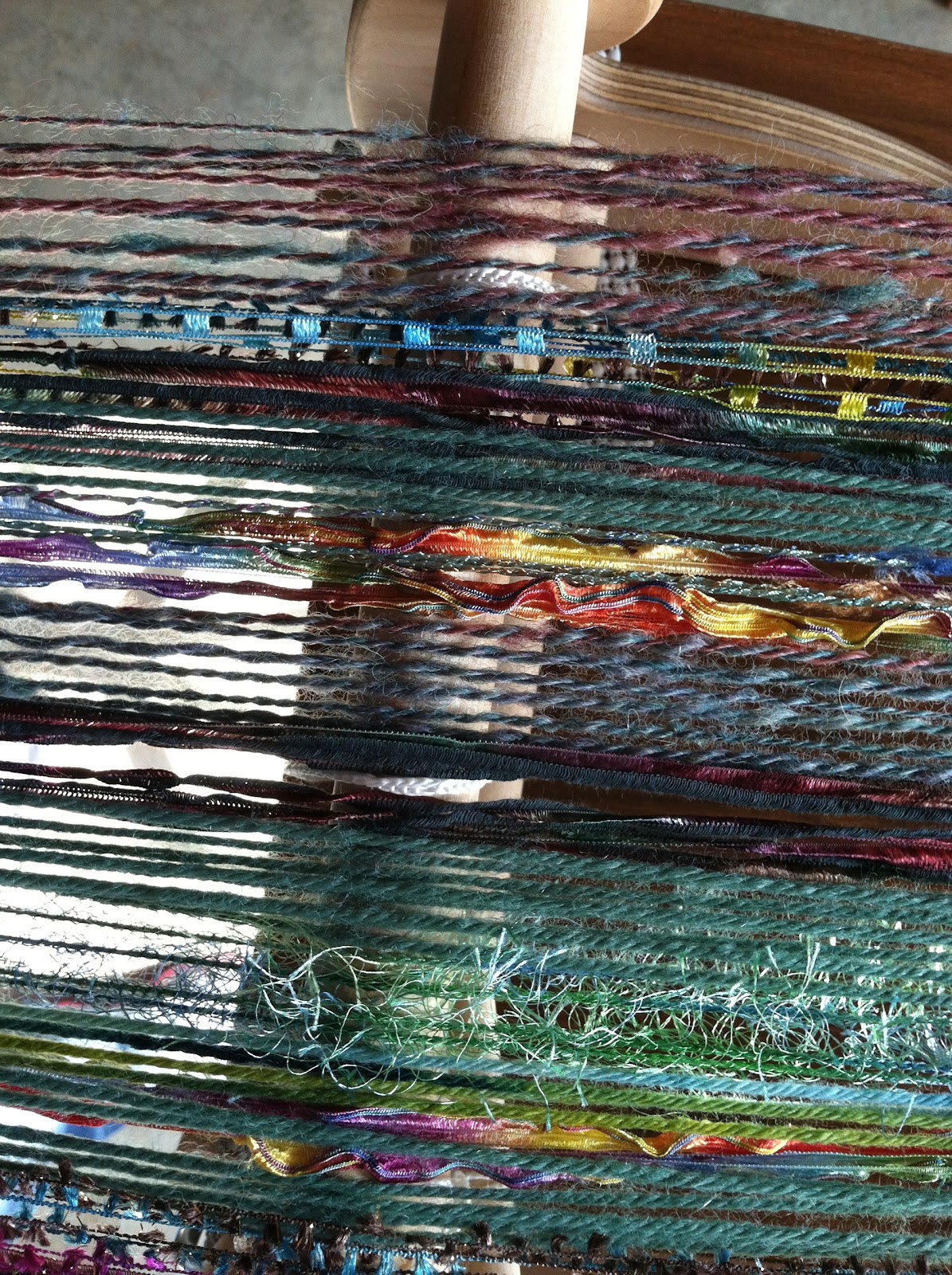
Close up of project on 16s Toika
Napkins being woven on 16s Toika


I am trying something new.
Both looms currently have projects on them and I am going to write a blog post daily about the things I know best.  After weaving for more than a decade, I have learned many lessons.

1.  Keep records.  I have used several different project planning sheets, some found online and other from classes I have taken.  As a result, I have created my own personal planning sheet to include the calculation that are important for my planning process.  I start every project, even samples, by recording my project plan.  It includes all the information about the warp, weft and finished project.  I calculate my warp length and the total yards of warp yarn required to weave the project.  In addition, I calculate my ppi (picks per inch) and the total yards of weft yarn required to complete the project.  If I am uncertain about how much yarn I have in the color I plan to use, I will weigh it and calculate the yards on the cone.

2. Sample.  Include at least 18-36" of warp yarn for a sample when calculating the length of your warp.  Make certain you include enough warp to take the sample off the loom when it is complete and tie the warp back on the front apron rod.  My first samples neglected to include at least 6-8" for retying after removing the sample and I almost ran short when weaving my final project.

3.  Be willing to make changes in your sett and ppi based on the results from your sample.  In fact, be willing to change your weft yarn altogether.  Your sample should include weaving with several different colors to be certain you have chosen the one you like best.  If you change the sett of your warp, you will need to resley your reed.  If you choose a different size weft yarn, recalculate your total needs on your project planning sheet and check to be certain you have enough yarn.

When it comes to project planning, the most important single lesson I have learned is to be open minded.  You may have conceived of your completed project one way and your experimentation on the loom may take you in a different direction.  Make sure you leave enough warp length to sample each idea and be willing to try different things when you sample.  It will lead to the best possible result.

I could bore you with several stories of how I started with one idea, ran out of yarn or found a different way to do it when sampling and those things led to a different result.  Your sample is a time to have fun and try crazy things.  Don't dismiss anything, try it all.  Save your samples and file them with your completed project plan and a snip of the finished project if you can.

I'll write more about the pictures at the top tomorrow.  The planning was fun!

Tuesday, December 17, 2013

Farewell to Julia

Over a year ago I purchased a weaving kit, something I rarely do, for a Bronson lace shawl made with alpaca/silk.  It was a good deal from Yarn Barn of Kansas.  The yarn was on the expensive side and the draft was easy enough.  I made it for my best friend.  I should say I cursed, struggled and pulled my hair out over that shawl.  It was my second 8 shaft project on the Julia.  The first, a simple twill bread cloth, was not a success.  I adjusted the 8 shafts, lamms and treadles on my Julia countermarch loom an easy dozen times before I finished that shawl.  It's a beautiful piece.  I'd love to make another one but not on that loom.  Julia and I are parting ways.

After I finished the shawl, I took 4 shafts off the Julia and wove several other items successfully.  I concluded that Julia and I do not work together in 8 shafts.  After a while I began thinking, how ridiculous.  I bought an 8 shaft loom.  I want to weave 8 shaft patterns.  The only conclusion I came to was that I needed to sell the Julia and buy a different loom.

So, after several months and several postings on weaving sales sites, Julia is heading to a new home.  I hope you enjoyed my little video tribute to Julia.

Next week I'll return with some big baby wrap news!

Merry Christmas to all!!

Wednesday, September 19, 2012

What's new on the loom

I just finished warping and threading my 10" Cricket loom for a project I am very excited about.  It's another scarf but it's a sample for a vest I'm hoping to weave next.  I love doing different things on my rigid heddle loom.  It's small, lightweight and portable and there is so much weaving you can do on it.  Many weavers who have spent years mastering the craft do not approve of rigid heddle looms.  I have heard some refer to them as child's looms or toys.  Believe me, this is no toy and not easy to master.  Plus, there is tons you can weave on it.

My Cricket loom has only 2 shafts which limits you to plain weave.  Why is it called plain weave?  Is it the simplest weave structure? No, not by a long stretch.  It's plain weave because it is the most basic and it's where weaving begins.  Plain weave is not an easy structure to master.  It is very challenging to weave for 70 or 80" and have the distance between warp threads match EXACTLY the distance between weft threads.  In other words, if the warp is sett at 8 ends or threads per inch you must place/weave the weft or perpendicular threads at the same ratio, 8 picks or threads in each inch.  Not an easy task and one that requires measuring frequently to be certain you have passed the shuttle and pressed the threads into place exactly the same each time.  Something to strive for but not easy to maintain for the 72" of weaving when making a scarf.

So, it's off to complete the placemats on Julia.  Two are done and two to go,  We just added a new show to the line up so it's weave, weave, weave and knit for the next 2 months!!